Showing posts sorted by relevance for query gifu. Sort by date Show all posts

Wednesday, February 1, 2017

Gifu and the Cormorant Fishing Boat

I think my first post of 2016 was about meeting in Gifu with a builder of these: cormorant fishing boats. Gifu is the most famous place in Japan for this kind of fishing, which is done at night and now is a tourist attraction, with over 300,000 people a year riding observation boats watching six fishermen on the Nagara River. Forty-two feet long and a little over three feet wide. The plan is for me to come back mid-May to start this project.

My friend Masashi Kutsuwa (right) a furniture instructor at the Gifu Academy of Forestry, has been an invaluable partner in this project. He organized a meeting of people interested in the research and we gathered last Monday evening at the school.

Mr. Seichi Nasu, 85, is perhaps the last builder of these boats. His sole apprentice was the original boatbuilder I was going to work with, but he seems to have stopped working. So our project had to pivot and Nasu san agreed to direct me building a cormorant boat. He still builds smaller boats from time to time but in this project I will do all the physical labor while Nasu supervises.

A branch of the Nagara River and the view from Nasu san's shop.

He's just completed building three of these rice field boats for a park. At the meeting Nasu san told the audience he has built over seven hundred boats in his seventy-year career. If so he's the most prolific boatbuilder I've ever met in Japan.

A historic image showing how the boats were once used. I built a similar type of boat exactly a year ago in Himi, Toyama.

Interesting long overhang to the stern of the rice field boats. The operator stands on the stern deck.

Nash's san's saws.

A wonderful home-made ink line. He uses red ink for some reason. I've only ever seen black used.

In retirement Nasu san likes to do these carvings of Buddhist figures.

The day after our meeting we organized a tour of Nasu san's shop, and saw his rice-field boat.


So in the Gifu region boatbuilders use a square-shanked nail. I've never seen this anywhere else, though temple carpenters use a similar type of nail in roof framing. Otherwise boatbuilders' nails are forged from flat steel.

The other unique nail is the kasakugi, or umbrella nail. It has an angled head and is used to connect the garboard plank to the bottom. Nasu san made a point of saying he likes to soak his nails in brine to get some rust on them. He says it gives them a grip in the wood and they hold better. I've heard this technique from one other boatbuilder here.


The heart of the beast: these sticks are Nasu san's patterns for building the cormorant boats. They are plank angles for each plank at various spots along the hull. He uses no drawings whatsoever and relies upon memorized dimensions for everything else he needs to layout the boat. The central point of my research will be recording all of this and document the techniques, getting it down on paper, photographs, and drawings for preservation.

This tool is called the momojiri, and is an ancient type of drill from China. You insert a handle in the hole then pound the chisel and pivot it. Nash san is the only boatbuilder I know in Japan using these, which he calls "momiji."

Nasu san uses this plumb bob and stick to set plank angles. He measures the horizontal distance between the string and a mark on the stick. This dimension is called hiraki and he remembers all of his angles as the horizontal measurement. This is pretty standard among boatbuilders throughout Japan. Interestingly most builders call this tool the sagefuri, but while my Tokyo teacher used one he told me it had no name.

Everyone wanted a portrait of Nasu san and me with his latest boat. I've been visiting Nasu san for almost twenty years, and while he was friendly (he gave my wife a bailer when she admired it) I could never get him to agree to teach me. As he got older it became untenable because he could only work a few days a week on a large boat. So last year we decided I would work with his apprentice and then that fell through. I am obviously grateful Nasu san has agreed to do this, mostly because he truly is a master of these boats, and he's also a wonderful man.

We'll be living in Nasu san's town of Mino, which is famous for the preserved architecture of its old town. Those second floor wall extensions were to stop fires from spreading.

As Mino became wealthier, it became fashionable to show off one's wealth by embellishing them.

We also toured the Gifu City boatshop. They build all the tourist viewing boats while Nasu san has built the actual fishing boats. Note the modern take on the sagefuri, which I think the shipyard boatbuilders made and is not commercially available. I also love that vise grip clamp.

River boat builders tend not to brace their boats overhead for some reason, instead relying on heavy weights place inside to fix the hull while planking. Nasu san uses a pair of small boulders.

One of the shipwrights drilling and setting nails in the planking.

He had a great tapered twist drill but he finished every hole with the traditional momjiri.

Typical style of scarfing planks in Japan. Note how close the two scarfs are to each other, something we are taught is bad in western boatbuilding. I'll need to quiz Nasu san on whether there are any rules about spacing or overlapping scarfs.

The six active cormorant fishing boats taped for the winter. There are six usho, or fishermen in Gifu. The senior fisherman is the 17th generation of his family to do this work, which runs from March to September, I think. There are about five other places in Japan where they do this, but with 2-3 fishermen only (and one woman usho in Uji City near Kyoto). Gifu by far is the most famous place for this.

Tuesday, April 29, 2014

Birds and Boatbuilders

I had a very full day yesterday, traveling two hours to Gifu City where my friend Masashi Kutsuwa teaches furniture-making in a program run by Gifu Prefecture.  He's been very interested in the culture of cormorant fishing, which is the major tourist attraction in Gifu City.  He has taken students and studied the basketry used by the fishermen (used to carry their cormorants), and the boats.  Years ago I met Mr. Seichi Nasu, the last builder of cormorant boats.  Since that first meeting I've gone back to see him several times.  He had an apprentice many years ago, a man who then turned to making wooden bathtubs and buckets, but who has recently gone back to boatbuilding, especially since Nasu san, at eighty-two, has become too old to build the large fishing boats.

If you don't feel like reading everything here, you should at least consider scrolling down and seeing the video links I've posted.

I passed through Kyoto Station on my way to Gifu, which is in the mountains on the banks of the Nagara River.

Kyoto Station

Our first stop was the Gifu City boatbuilding workshop.  Here the city has three boatbuilders making the tourist boats that watch the fishermen work.  They had just started a new boat and had the bottom set up for assembly.


Nails have become a real problem for boatbuilders across Japan.  Traditionally in the Gifu region they used a nail with an angled head, but now there are no sources for these nails and the boatbuilders I met yesterday have all taken to pulling them out of derelict boats.  The new nails have squarer shanks and come from temple carpentry.  


Boatbuilders use a very interesting tool to set plank angles, but the city boatshop had a novel take on the old idea.  A piece of plastic mounted on the wooden bar had hash marks for the proper angle of various planks.  Below I show the traditional version.


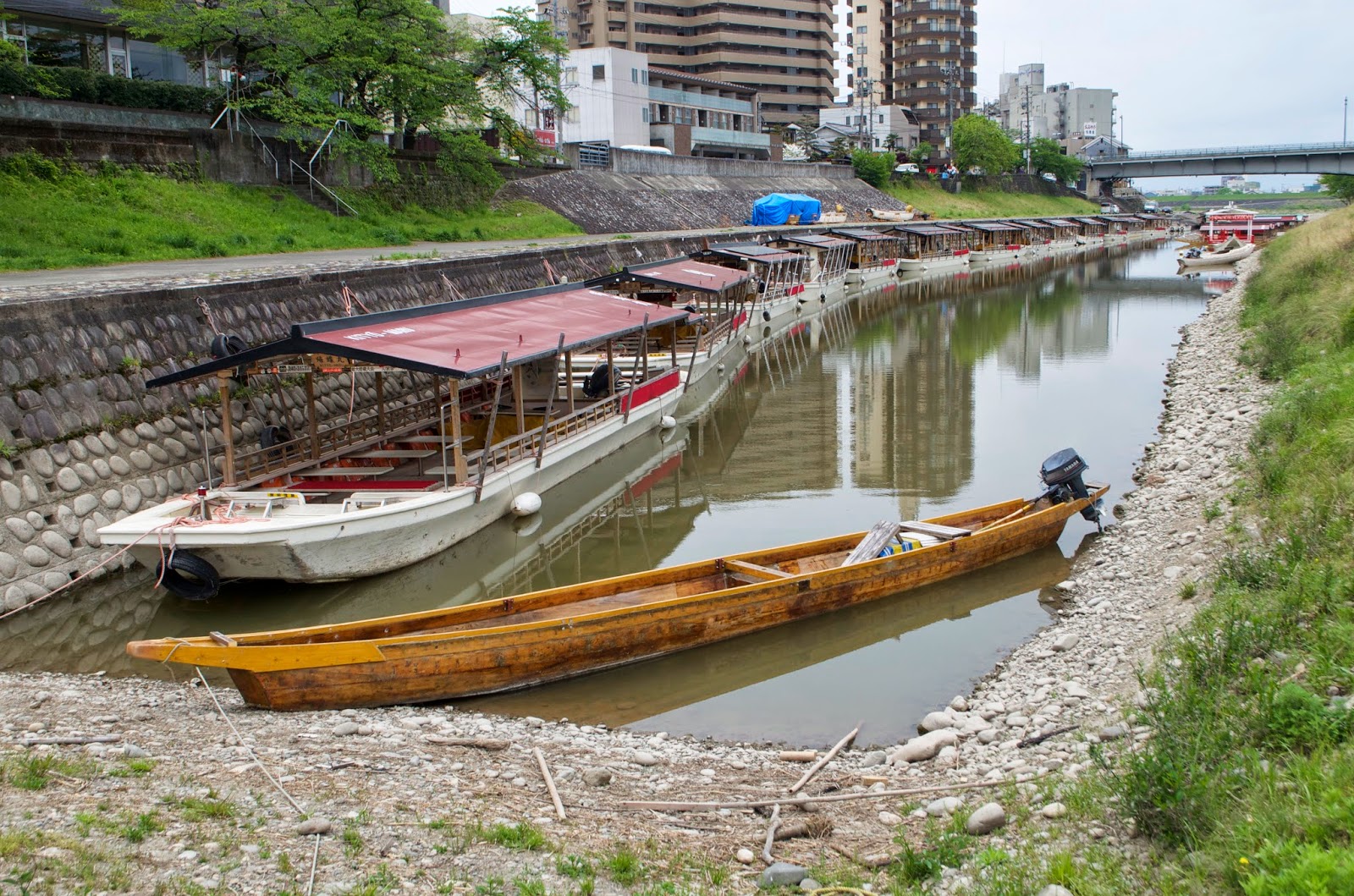
Here is the fleet which contains the boats the tourists ride on (large and small) as well as a boat containing a men's and women's bathroom, several rescue boats, and in the foreground an actually uakibune, or cormorant fishing boat. Some of the large, white boats were fiberglass, but most of these boats are wood.


A segue here to the furniture school, which enrolls about twenty students in their two-year program.  Tuition is about $5,000 a year with students living in the community.  When I showed up the visiting tool salesman had just arrived, with his large customized van outfitted as a rolling tool store.  These very high quality tools at matching prices.  The lovely inklines were made by a retired temple carpenter.  I loved the drum-like hammer, but at $250 I figured I could leave it on the shelf.

I lectured to the first-year students that evening.

A well-stocked tool store.

Showroom of student work.


The program is trying to encourage students to develop wooden products based on local traditions and needs.  One of last year's graduates is now making geta, or wooden sandals.  The shot above was a project were all the students made very small carving chisels and planes and each had to make a bowl with them.

Then it was upriver to Nasu san's shop.  His former shop was close to the river and the government decided to concretize the river bank, so he built a new shop further uphill.  I liked the fact that he demanded the traditional clay floor in his work area.


He told me he had taken to carving models of his boats to try and work out designs.  Surprisingly crude but he insisted it had been a worthwhile exercise.  

These patterns are Nasu's record of plank angles.  Like all river boat builders I have met in Japan, Nasu has never used drawings.  All dimensions are memorized.

Nasu san is currently building a small boat for ayu fishing.  I am building the same type of boat here in Kameoka, though the two boats look very different.


I have included two videos here of Nasu san using the momojiri and then driving a nail.  The latter is incredibly entertaining, a technique I have seen other boatbuilders use.  Nasu san insists its vital to have a feel for how the nail is driving, because the planking is so thin.  I am convinced there was just an element of fun in this, something to lighten the work in the shop.  This technique is called "uguisu no tani watari," or the "bush warbler flits across the valley."  A poetic name for an intriguing technique.  My friend found another video showing some Tokyo candy-makers doing a similar thing.

Nasu san at work:   http://youtu.be/wv4JBLxyZac
                                http://youtu.be/t2rhHFsTUws
                                http://youtu.be/lOSioPgsDu0

Tokyo candy makers:    http://youtu.be/wOj0xClapC4


The Nagara River in front of Nasu san's house and shop.


From Nasu san's shop we went to Gujou City to see his apprentice, Tajiri san.  He is 52 and now building a new ukaibune fishing boat.  He showed us the traditional tool for setting plank angles.  The boatbuilder simply remembers the horizontal measurement from the line to the stick for each angle.

This pattern is also used to set plank bevels.  Tajiri san learned this technique from Nasu san.


This bottom planking is almost 35 feet long, but amazingly just over an inch thick.  Tajiri san told me he makes the bottom with a slight curve, but that water pressure will flatten the bottom.  He also said the boat will be flexible and this is safer.  The fishermen work standing up and the boats are incredibly narrow for their length.  A flexible boat is less apt to capsize.

I stayed overnight with my friend and this morning we took a look across the river where the six usho (cormorant fishermen) live and keep their fishing boats.  This is an inherited position and technically Gifu's six fishermen are employees of the Imperial Household Agency that administers the royal family.


The cormorants live with their owners.  They work for ten years and are retired, but kept by their owners until they die a natural death.

Cormorant boats have a distinctive foredeck and stern deck.  The fishing is done at night and the boats carry charcoal lanterns to attract the fish (ayu).  The birds wear brass rings around their necks to prevent them from swallowing the larger fish.

Scarf joints in the planking.