Friday, August 9, 2013

Improvisation


One of the things that has struck me about Japanese boatbuilding is the degree to which during the construction of a boat the builder makes changes that deviate from the original drawing.  All my teachers who used drawings worked from a 1/10th scale image.  Scaling from that size is inaccurate, yet the drawings were just a starting point for them; during construction issues would come up with the material and changes would be made on the spot.  The process of sawing to fit planks can easily remove more than 1/4” of material.  As a result the final boat could deviate considerably from the measurements first laid down on the wood.

Photos here show my apprentice, Takumi Suzuki, fitting the kajiki with our handsaw, and then cutting the nail holes with a special chisel.

In the West boats are generally built around moulds that define the shape exactly.  If the builder is careful in building their mould from the lofting the boat should conform exactly to the plans.  But Western boats are built of thinner and narrower planks for a given size than Japanese boats, and are much easier to force into a particular shape.  The Japanese builder has to struggle to bend thick, wide planking, and it doesn’t always work out the way one might intend.

In our boat I tried to keep the angle of the kajiki consistent with my lofted lines, but at the forward station (called in this region the habadokoro, literally “width place”) I just felt we were forcing the planks too much, so I let them stand a bit tall.  Our kajiki are probably 3/8” higher at the chine than designed.  

When we hung the second kajiki yesterday I tried to keep the planks at the same angle, but at the aft habadokoro the starboard kajiki stayed a bit low after we nailed it.  I tried propping it higher but decided against putting too much strain on the plank and risking cracking it.  I will try raising one plank and dropping the other and get them as close as possible.

Again, I saw all my teachers basically abandon their drawings fairly early in the process, opting for sound construction techniques and overcoming unexpected issues.  In this respect Japanese boatbuilding is very improvisational.


Monday, August 5, 2013

Fitting the kajiki


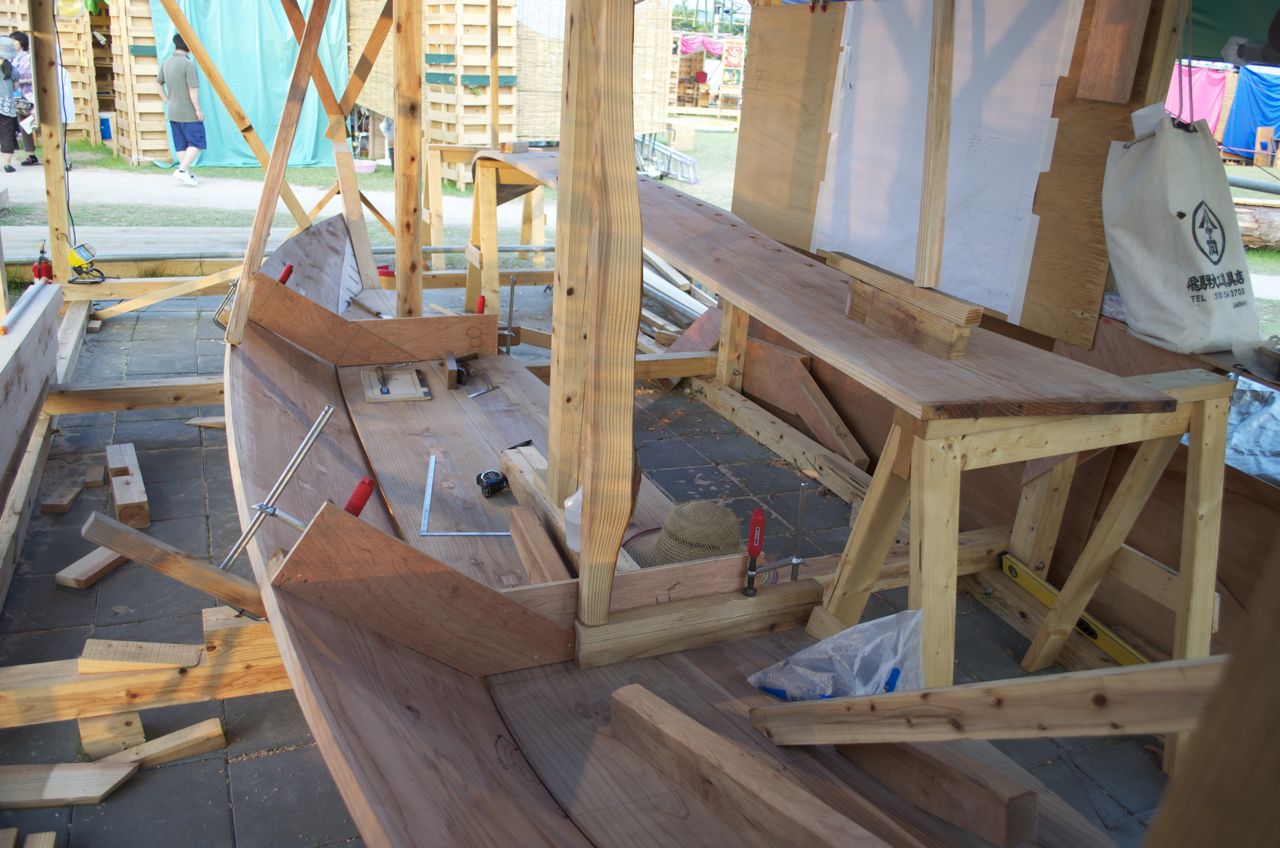
The first plank on the boat is called the kajiki.  In the West we would call this the garboard plank.  After propping it securely in place, we did the saw-fitting technique used earlier when we assembled the bottom plank from two pieces.  This is especially difficult between plank seams, in part because the seam curves, but more because at any moment you can be sawing against the grain of one plank or the other, and this has a tendency to catch the saw and carry the blade into the plank.  My apprentice Takumi Suzuki spent most of the day sawing the seam for the first kajiki.  He had to carefully position wedges to open the seam up enough to not pinch the sawblade.  It is slow work, not to be rushed, because we are going for a watertight fit.  I worked fitting the plank at the transom and stem.  One photo show the fit at the transom after sawing the seam.

We also sawed along the stem rabbet, and then pounded the plank at the aft end with a mallet, slowly moving it tight into the rabbet joint.  Note in these photos you can see the interesting shape to the bottom plank (called here the kawara).  Aft of our joint the plank rises, and this creates a rounded shape aft in the kajiki.  This is a tricky spot to both lay out and get fair, and is probably far too much to explain in a blog posting.  Sorry.

Now that the plank has been fit we can begin the process of nailing it.


Tsuzu


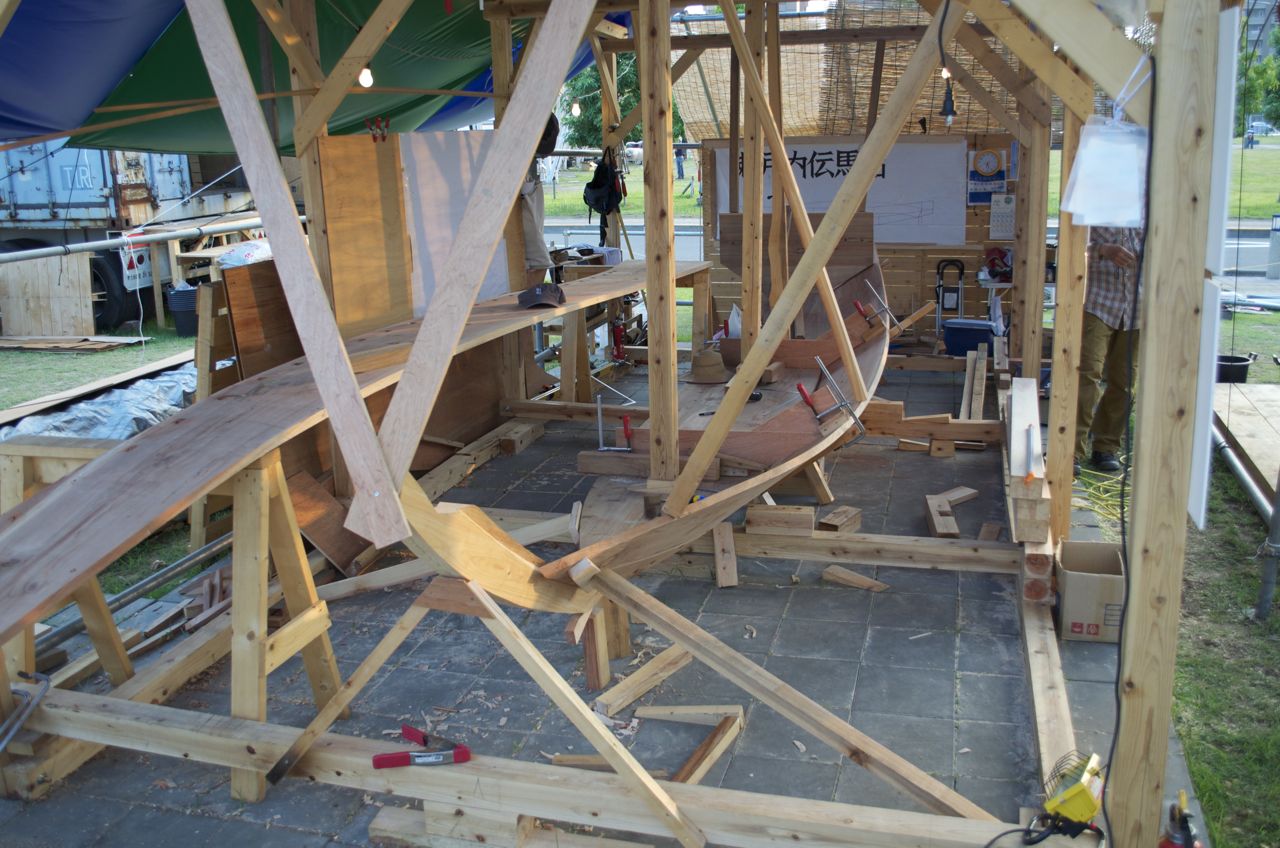
In this part of Japan the props we use to hold parts of the boat in place are called tsuzu.  Elsewhere in Japan my teachers also called them tsukai bo or tsuppari.  Whatever you call them, they are absolutely integral to traditional boatbuilding in Japan.  The shop itself is also a critical tool.  All the shops I have worked in had heavy overhead beams, all to bear the pressure of the myriad props used in building.

Our structure is built of 90mm x 90mm beams (almost exactly the same as an American 4 x 4), entirely bolted together.  However, when we started to prop the kajiki (garboard plank) in place, we not only moved the boat but we deformed the top beams and at one point lifted the entire structure!  So we have tried to prop against the bottom beams rather than the floor, and I clamped two additional beams overhead.  Nevertheless the whole arrangement is dicey, but we’ll make it, and in the future we will build this a bit differently.

At the stern I used a pipe clamp, which has been very handy.  Ordinarily Japanese boatbuilders use few, if any, clamps in this situation.  I have seen them use rope and a Spanish windlass (twisting the rope tight with a wooden bar).  I have attached one photo from my second apprenticeship in 2001 showing the props we used to hang the kajiki on the bekabune, a boat I built at the Urayasu Museum with Mr. Nobuji Udagawa.  You can even see props pushing against props, something we too are doing here in Takamatsu.  


Sunday, August 4, 2013

Visitors


We get some interesting visitors to our workshop.  One morning a man came, sat down, and watched us working in complete silence.  I finally made an overture to him and he mentioned that he had been a house carpenter.  I invited him to step into our shop for a closer look and he picked up my plane, looked carefully at it, and then marched over to our sharpening stones, took the blade out and began to sharpen it.  When he was done he sharpened another plane.  Then he grabbed my bag of tsubanomi (the chisels we use to pilot nail holes) and he sharpened all of them.  He’s been back a couple of times since and always watches us wordlessly.  I noticed last week he’s working as a parking attendant for the Festivale.

One of the Bengali instrument makers came over with a partially made guitar and asked Takumi if he would use his power tools to rough out the top where he will be carving a bird.  Several of the other Bengali craftspeople have asked about our power tools, as evidently many of them have no access to them in Bangladesh.  This man told us he works sometimes as an itinerant instrument maker, traveling among villages to make and repair instruments.  

Yesterday a very small, older man came by.  He made motions of sawing on the boat and I asked him if he was a boatbuilder.  He said he built large plank-on-frame wooden ships in a local shipyard and he showed us photos of the models he currently makes.  The construction of ferries must have been a huge business here since the Inland Sea is dotted with islands big and small.  He seemed charmed by our project.  Several other people have reminisced about their childhoods living on the islands, sculling small boats like the one we are building.


Saturday, August 3, 2013

Bengali Shipwrights


We’ve been sharing techniques and tools with our neighbors at the Festivale, a pair of Bengali shipwrights who are assembling a 12-foot dinghy.  Its a remarkable boat.  They had it shipped here finished, then took it apart at the futtocks and have now begun to reassemble it.  

All the plank edges have a shiplap and they scarf the planks using a joint similar to the one we used to connect the stem and keel.  Today they showed us their method for pulling the planks tight before fastening.  A large jute rope is anchored to a piece of bamboo on one side of the boat then wrapped around the hull and pulled tight with a large hardwood lever.  They pulled the boat together with three of these and then fastened before moving forward.

The nailing is from both inside and outside the hull.  The nails are cut from sheet steel with one beveled end.  They cut a small mortise across the seam and pound the pointed end in, then bend the nail and hammer it into the other end of the mortise.  You will notice the seam is not centered on the nail, but the nails on the exterior are aligned opposite, so the fasteners are equalized.  The other reason the nails are not centered on the seam is that with a round hull they would stand proud in the center where the curvature was great.

Their interpreter has told me that this technology also applies to larger ships in Bangladesh.  He and the shipwrights are part of an NPO working to preserve the culture of boat and shipbuilding there.  


Friday, August 2, 2013

Yakimage


The term yakimage means “heat bending.”  The use of an open fire to bend planking is used throughout Asia, and its also familiar to the Bengali boatbuilders working near us.  The planks are bent slowly, off the boat.  In old photos and drawings often one can see stones used to weigh down the plank ends and though none of my teachers used weights, I tried it here.  It makes sense, because the weight applies a constant pressure.

First we beveled the plank edge where it meets the bottom, then cut our nail holes from the inside and made matching mortises on the outside.  

My teachers also all used props braced overhead to bend the planks.  I found it easier here to use pipe clamps pulling down against the metal framework of our shop.  The clamps let me apply steady pressure very slowly.

While the fire burned underneath the bending point we also poured hot water on the top of the plank.  We had to keep spraying water underneath to keep the plank from charring.  The whole process took us about six hours.  In the West, wood that comes out of the steambox has to be bent immediately.  The nice thing about this method is we can take our time.

Bending to the exact curvature was never something I saw my teachers attempt.  They bent by eye and then manipulated the plank on the boat to the final curve.  I made patterns of both the curve we wanted and the twist, and while I tried to match them to the bend I don’t think it was so precise.


Design of the Setouchi Tenmasen


A bit out of order, but a reader mentioned that I had not written much about the boat and its design.  The boat is a tenmasen, a typical small cargo boat from the Inland Sea region.  The lines drawings are from the Seto Nai Kai Museum and date from the 1950's or 60’s.  Boatbuilders always drew their boats on a plank of wood to a 1/10th scale.  The boat was built in Ushimado, a small waterfront community now part of Setouchi City.  Very typical Japanese small boat style, with the aft end of the plank keel uplifted, and two planks per side.  One interesting feature is the two piece transom which is not in one plane but joined at an angle.  In the drawing you can see the two stations used by the builder, another common element of boatbuilders here, who used far less reference points than their western counterparts.  The boat’s overall length is about twenty feet.  This boat would have been propelled off the stern by a ro, or Japanese sculling oar, similar to the Chinese yuloh.  

The image here is a design made by my apprentice, Takumi Suzuki.  He used the original lines drawing we got from the museum and added graphics and labels.  The design is for a tenugui, or a traditional hand towel.

And I will give another update on other blogs going on around this project.  One is being written by my apprentice and the other by my project partner Koji Matano.  You can also find video clips and links at the other blogs.

http://woodenboat.jp/setouchi/ (English and Japanese 日本語)
http://hacarame.com (Japanese only 日本語)