I am now in Asia for seven weeks of research in Japan and China. This trip is sponsored by the Asian Cultural Council of New York and is a follow-up to my research last year building the cormorant fishing boat in Gifu. The goal of this trip is to meet and interview river boat builders, specifically those who build cormorant fishing boat. While Gifu is by far the most famous place in Japan associated with this fishery, its also done in about ten other spots in Japan. Now all cormorant fishing is done as a spectacle for tourists, but this was actually a bonafide commercial method of catching ayu, a small sweetfish, well into the 20th Century. In China I will be visiting Guilin, one of the most famous spots for cormorant fishing, where again it takes place today only for tourists. Finally I will visit Shanghai and go to Ningbo to see one of China’s largest maritime collections.
This trip will fill a significant hole in my research. Until last year I had never studied with a builder of river boats, and I had only met a handful of such craftspeople, as my travels have been almost exclusively along Japan’s sea coasts. My first six teachers built sea boats only. What I have learned to date about river boats builders leads me to believe they are far more isolated than the craftspersons I have previously studied. In some ways this isolation creates even more variety in the craft, which this trip should illuminate.
River boats are attractive to me, not just for their aesthetic and cultural value, but because they are in my view the ideal boat for teaching Japanese boatbuilding. They are relatively simple compared to sea boats, so they lend themselves well to short-term workshops. The wide, plank bows seen on most river boats relieves the bending necessary for the side planking, eliminating the need to bend by fire, something not conducive to the typical classroom. To date I have taught four kinds of river boat designs in my classes.
I landed in Tokyo and on my first day visited my second teacher in Urayasu. Mr. Nobuji Udagawa and I built a bekabune together. He is now 88 and its hard to believe its been seventeen years since we worked together. Then, at age seventy, he could work circles around me, forty years old at the time. I also visited the family of my third teacher Mr. Kazuyoshi Fujiwara. He passed away last spring at age 94. Again, a remarkable craftsman and human being.
I left Tokyo and headed across Japan to Niigata, where my friend Ms. Yoko Arakawa met me and we then headed up the Shinano River. She had arranged for me to meet two boatbuilders, one she had met several years ago and the other a man I learned about and had been corresponding with via his daughter-in-law.
First we met Yoko’s contact Mr. Nakagawa. He is 81 and a second generation boatbuilder. He did a five year apprenticeship with his father, who initially was very busy building small rice field boats until lagoons were drained to build road after the War. Nakagawa and his father built 10 large korembo cargo boats, up to 75-feet long, and 10 smaller sanpasen. For the larger boats they switched from wood to steel about 1970. Since then he’s built wooden boats now and then for organizations and events.
Nakagawa san listed the various types of boats of the region: koyashibune (night soil boat), nagabune (literally “long boat”), korembo (large cargo boat), shikibune (one piece bottom), itaawase (literally “plank built"), honryoubune (literally “real fishing boat”), and sanpasen. He bought his cedar locally; he said rich people had large trees on their properties. There were two types of sawyers: those who cut the trees down and those who ripped them into planks. Large trees would be ripped in half in order to transport. I measured the small boat he had just built. A new larger boat he had just fiberglassed he built for $8,000.
From there we drove to Katayama san’s house and had a good time talking to him, seeing his shop and looking at one of his older boats by the river. He is a third generation boatbuilder. He stopped building boats around 1960 when demand fell off, but before that he was building as many as four boats a month in the busiest period of 1945-1950! The types included kobune (24 feet), nagabune, and doutakabune (large cargo boat). He bought his wood locally, usually cedars 6-8 feet in circumference. Power came before he was born but he only used hand power tools. After 1960 he worked as a tategu-shi (interior joiner) and now makes picture frames for a famous artist.
Then we went to see the korembo boat replica, built 11 years ago at a cost of $70,000. It is 6 ken long (36 feet) but in the old days they were as much as twice as long. The planking was all full length! The precursor to these boats was the doutakabune, which were 40-60 feet long.
Last year while working in Gifu I attended a furniture symposium in Nagoya. There I met Mr. Tak Yoshino, one of Japan’s most famous furniture makers. Specifically he is famous for his Zen Chair, a remarkable design intended to support the body with perfect posture. He custom fits his chairs to each customer. After attending law school Tak apprenticed with a furniture maker and then a National Living Treasure sashimono maker. Sashimono craftspeople make small wooden items like boxes. For the last thirty years Tak and his family have lived at the base of Mt. Fuji where he has a shop, teaches workshops and has two apprentices. He has begun the process of building what he hopes will be an international woodworking training center. Like me he is asking himself how craftspeople can be supported, in particular how to create a new generation of craftspeople. The concept of crafts schools is a very new one in Japan, where the crafts have heretofore been nurtured by a traditional apprentice system.
Tak and his wife were wonderful tour guides. We traveled around his home in Kawaguchiko for a day, first seeing a minka (farmhouse) museum in a small village. The house is 300 years old and the waterwheel is fully functional with a grinding wheel for grain.
We then hiked the forest at the base of Mt. Fuji. This is infamous as the location of many suicides but Tak san objected to its reputation, saying it denigrated what is otherwise a beautiful and unique landscape. The forest represents 1,200 years of recovery from a massive lava flow, and the flora show interesting adaptations. The trees are primarily cedar and they grow incredibly slowly in the thin soil. We hiked to a small hill which has a completely different forest because the lava flowed around it. The hill is an apex forest primarily of beech.
Finally we visited a 1,200 year old shrine founded in 865 after the eruption of Mt. Fuji. The Emperor decreed that the local community establish a shrine in order to appease the mountain. The original shrine was destroyed by fire and rebuilt in 1606, and then this structure was disassembled, repaired and rebuilt in 1960 for the 1,100 anniversary of the shrine. It is famous for its seven massive cedars which date back to the shrine’s founding almost 1,200 years ago. The seven trees are all over 40 meters tall and range from 10-20 meters in circumference.
That evening I give a slide presentation at his house. It was overcast during my trip but the morning Tak drove me to the train station suddenly the mountain appeared.
Wednesday, November 7, 2018
Saturday, October 6, 2018
2018 North American Japanese Garden Association Conference
This is a direct follow-up to my previous post. My sojourn to the Pacific Northwest in September ended with a garden conference in Portland, where I spoke about Japanese boats in gardens. The conference was organized by the North American Japanese Garden Association and hosted by the Portland Japanese Garden. The Portland Japanese Garden, along with the Anderson and Meijer Gardens mentioned below, are truly the equal to anything one might see in Japan, though of course most Japanese gardens have deep and significant histories.
The Zen stone garden is meant to invoke the sea, with islands.
The Portland Japanese Garden recently completed a thirty-seven million dollar expansion, most of which was to create new education and exhibit facilities. The architecture is stunning.
In my talk I gave an overview of Japanese boats and featured some examples in gardens. This boat is at Korakuen, a famous garden in Okayama, Japan.
A boat I built for a private garden in Woodside, California.
I built this replica of a Tokyo canal boat for the Anderson Japanese Gardens in Rockford, Illinois. Photo by John Brand.
In 2017 I built boats for two gardens: first this river-type boat from the Hozu River, Kyoto for the Meijer Japanese Garden in Grand Rapids, Michigan....
...and this small tour boat for Ritsurin Koen in Takamatsu, Japan. The latter boat is not traditional, though I used traditional techniques and materials in building it. It is obviously purpose-built to carry six passengers and a boatman. Its actually a great way to view the garden, providing visitors with a unique perspective. Ritsurin Koen also has extensive waterways.
After the conference I hopped in my truck and headed for home, with one stop in Laramie, Wyoming to visit a former Middlebury College student and his wife. The following shots were all taken out the window while driving (probably not recommended). I cropped them to panoramas to remove the blurry foregrounds and guardrails. These shots are from Oregon, Idaho, Utah, and Wyoming. I quit these antics when the highway became crowded in Nebraska, increasing with big rig trucks all the way to home.
2018 Port Townsend Wooden Boat Festival
I've had a busy September, first driving from Vermont to Port Townsend, Washington to attend the Port Townsend Wooden Boat Festival, where I did a Japanese boatbuilding demo and gave a slide lecture. I'd last been to this festival exactly twenty-five years ago when I brought a boat I built for a museum in Vancouver, Washington. You can read about that project here.
I drove because I needed to bring cartons of my book to sell. After pricing the costs of shipping books, flying, renting a car, etc. It made sense to drive. At the last minute I loaded six crates of maple syrup made by a friend here to deliver to his daughter's home in Kettle Falls, Washington where he markets them at her local organic food co-op.
I was absolutely stunned by the growth of the wooden boat scene in Port Townsend since I had last been there. The Northwest Maritime Center is a huge facility with workshops, classrooms, offices, and supporting commercial space that oversees the Festival and other events. The Festival itself was impeccably well-run and worth anyone's time and effort to attend, up to and beyond driving 3,000 miles. Below are some photos from the trip.
Here I am conducting my demo. First I fit the seam between two planks using a special set of boatbuilding saws, then I edge-nail them together. Its a highly refined process and all the seams in a traditional Japanese boat are fit this way.
Here I am hammering the edges of the two planks before fastening. This crushes the wood fibers and once the boat is launched and water makes the planking swell these edges will expand, further ensuring a watertight fit. The process is called kigoroshi, or "wood killing."
I drove because I needed to bring cartons of my book to sell. After pricing the costs of shipping books, flying, renting a car, etc. It made sense to drive. At the last minute I loaded six crates of maple syrup made by a friend here to deliver to his daughter's home in Kettle Falls, Washington where he markets them at her local organic food co-op.
I was absolutely stunned by the growth of the wooden boat scene in Port Townsend since I had last been there. The Northwest Maritime Center is a huge facility with workshops, classrooms, offices, and supporting commercial space that oversees the Festival and other events. The Festival itself was impeccably well-run and worth anyone's time and effort to attend, up to and beyond driving 3,000 miles. Below are some photos from the trip.
The view over the dashboard in North Dakota. This turned into a massive thunderstorm that evening. I drove I-80 past Chicago onto I-94 then I-90 across North Dakota, Montana, and Idaho.
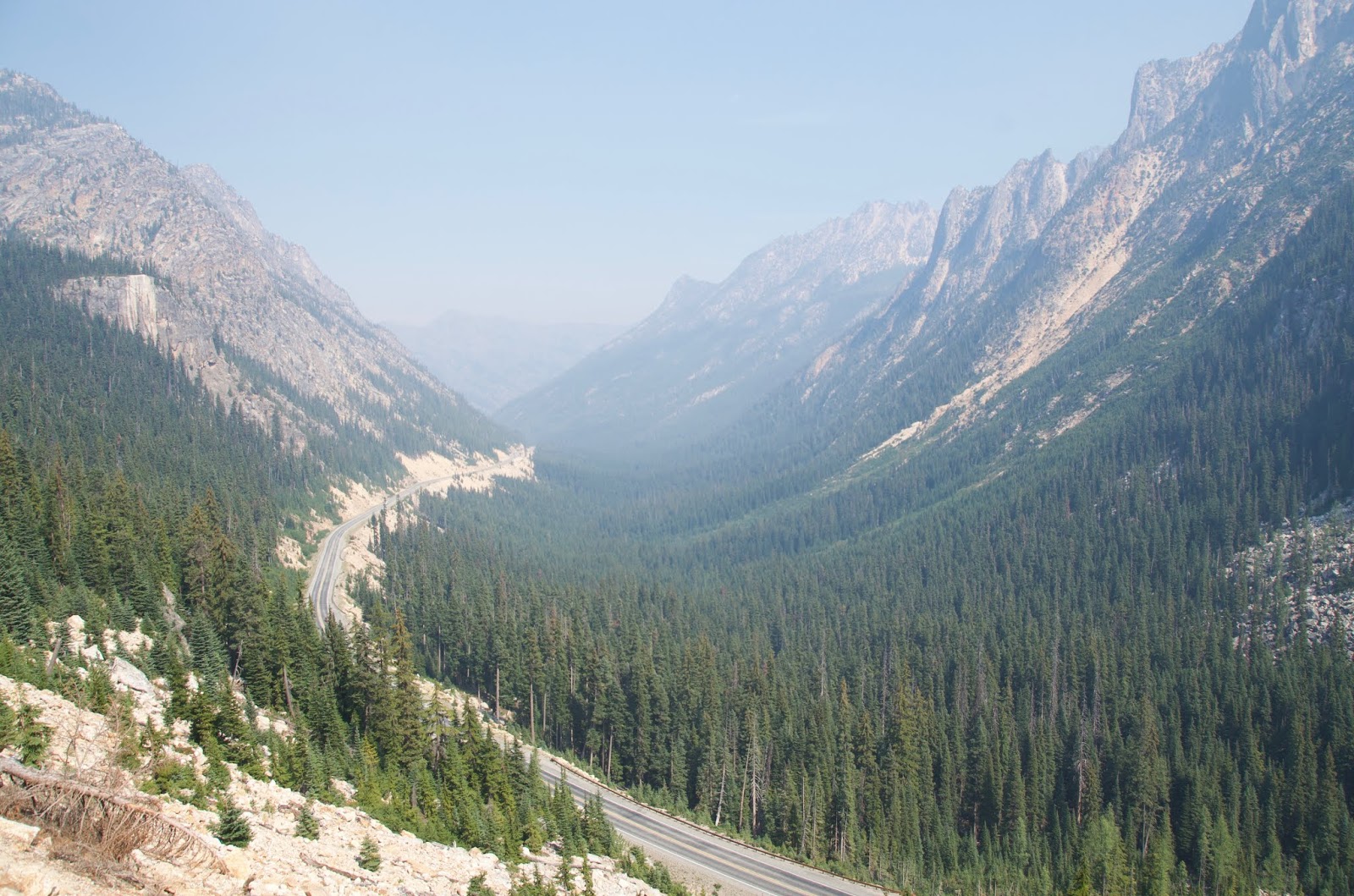
In Spokane I turned north to Kettle Falls, then decided to take Route 20 due west and through North Cascades National Park. I'd heard this was a spectacular and under-appreciated park and the scenery was gorgeous, though obscured by the smoke from forest fires. I drove through thick smoke from Coeur d'Alene, Idaho until I left the park, probably eight hours of driving, across several ranges and through the Okanagan Valley. The last stretch of Route 20 is actually the ferry to Port Townsend.
I was interviewed for a podcast while at the Show. The subject was the story of my research work on traditional Japanese boatbuilding.
This lovely Old Town canoe simply had its newer paint carefully stripped revealing a gorgeous original decorative paint job. The owner arrived towing this canoe behind his 1946 Chevy pickup.
Chesapeake Light Craft's display of kayaks.
Pygmy Boats' headquarters is right at the boat basin in Port Townsend.
The two buildings comprising the Northwest Maritime Center.
A gorgeous Rushton Wee Lassie built entirely of Alaskan yellow cedar. Striking beyond belief, the builder said the boat weighed eighteen pounds. Planking is 1/8 inch.
A stitch-and-tape boatbuilding workshop. My own demonstration was packed with spectators and my lecture was also well attended. Book sales were brisk enough to cover all my expenses, a major relief. I will be returning to the Pacific Northwest to give lectures again in March, 2019.
Carol Hasse has run her sail loft on the Port Townsend waterfront for forty years. Her work and advocacy for wooden boats is well-known in the region.
You'd never believe it was wood, but this, along with many other boats in the show, was built by apprentices at the Northwest School of Boatbuilding.
From Port Townsend I drove down to Portland and met my old friend Harvey Golden, who researches traditional kayaks and runs his own museum. He has two major books published on his research, which is honestly mind-boggling in its scope.
In his collection is a Chinese tub boat, reminiscent of the type I studied in Japan.
Harvey apprenticed with kayak builders in Greenland and has traveled the world studying and measuring historic kayaks in museum collections. Most of the boats you see in the museum are replicas he has built.
I flew home from Portland for two weeks, then back to attend the North American Japanese Garden Association conference at the Portland Japanese Garden, then got back in my truck and drove back to Vermont. Next blog post covers the garden conference.
Subscribe to:
Posts (Atom)