Saturday, January 14, 2017

Garden Boat for Takamatsu

I am back in Japan, here for about five weeks building a boat for a garden in Takamatsu. While waiting for my flight from Tokyo to Takamatsu I looked out the window at the gate and saw Mt. Fujii in the sunset.
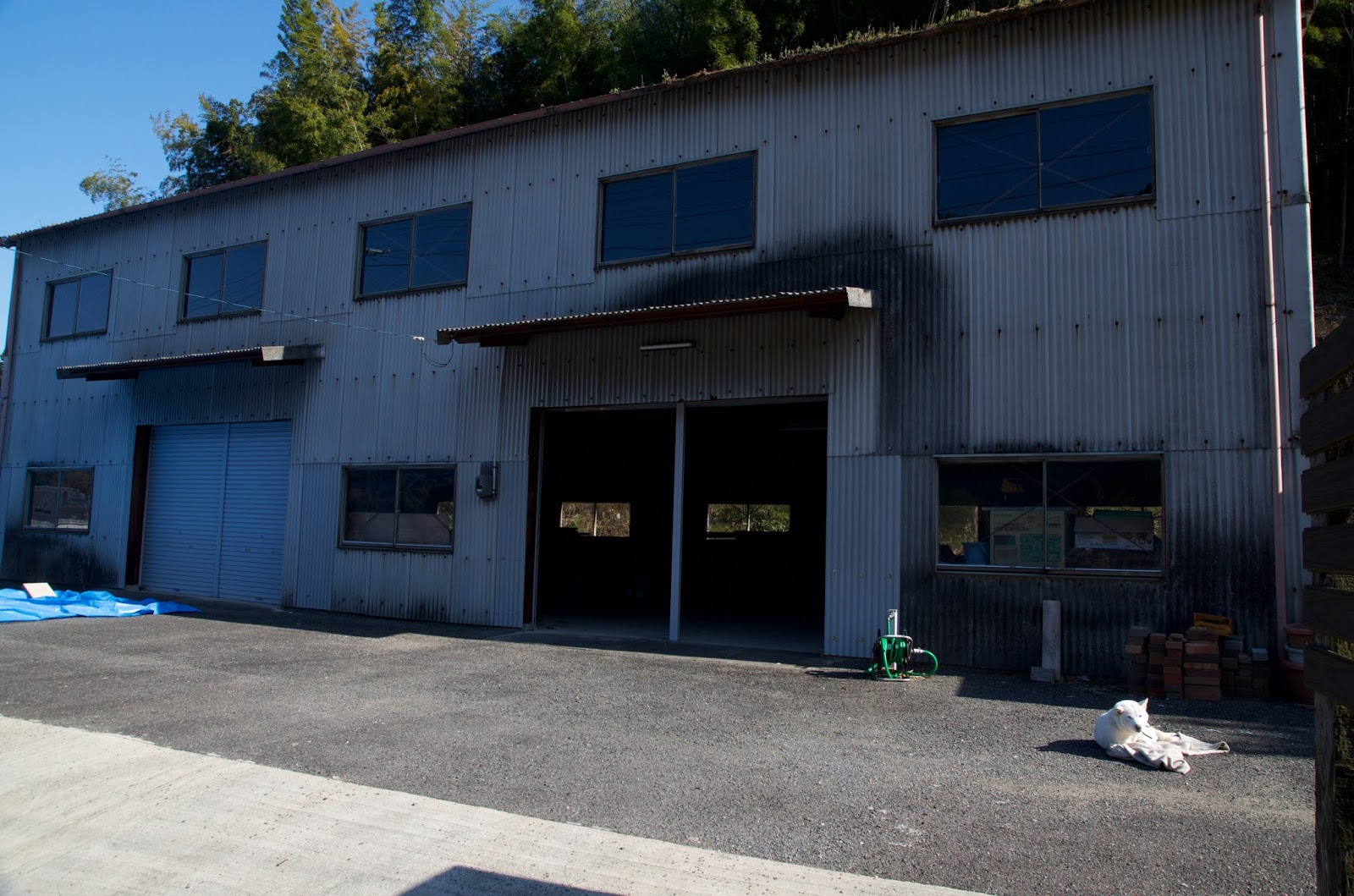
I am working at a company that makes cabinetry, mainly for ship interiors. This is a small building they have to store lumber. I am using one half to build this boat.

My lumber pile.

Even though its winter all the surrounding fields are cultivated in vegetables, the work of one young organic farmer. He stopped by to introduce himself and gave me some lettuce and radishes.

What a joy at the company's main shop to have them mill my materials. Previously in Japan all the boats I've built, either by myself or with my teachers, we used nothing more than hand tools and portable power tools. Here the owner runs a giant planer/joiner to surface my planking material.

From left to right a joiner/shaper, the joiner/planer, and a straight line ripsaw. It took us about one full day to mill all the materials for this boat.

On the straight line ripsaw I had my hinoki planking cut to remove all the sapwood.

This machine makes two parallel rips. Again, we fed the material to take off the sapwood. Overall the quality of the materials I have to work with are pretty extraordinary.

I found this boat rudder standing in one corner of the shop. The company founder, the present owner's father, started the business building boats, but that worked faded. He said this rudder was fifty years old. Its in the traditional style, cut from a single piece of hardwood (white oak) with a tapered stock that dropped through a hole in a beam across the stern of the boat.

I am staying at one end of this small fishing village, and visible is Shodoshima, a large island in the Inland Sea. I hope to go there in a couple of weeks because a group of people teaching themselves barrel-making gather every year at this time at a soy sauce factory to make large wooden tubs. I want to meet them and see their work, which is very similar to my own work making tub boats.

Friday, December 9, 2016

Lofting Workshop

Every year about this time I go over to Maine to the Carpenter's Boat Shop to teach a lofting workshop to the apprentices. We loft at least two boats, starting with a simple flat-bottomed skiff to introduce the concept to apprentices, moving on to a more complex boat. In years past we've lofted boats the Boat Shop was commissioned to build for customers. This year it was decided we'd loft the Catspaw dinghy, and apprentices will be building two before the end of the year.

In other news while in Maine I saw my friend Kenneth Kortmeier, and learned he's started the Maine Coast Craft School in Bristol, just down the road from the Boat Shop. Kenneth is the former furniture instructor at the Boat Shop, and he spent last summer teaching at the famous Country Workshops in North Carolina run by Drew Langsner. I look forward to seeing his new school develop so check out his website.

For lofting I set up a series of hollow core doors as a long table, and rolled out paper to loft our boats on. Working at a table is far more comfortable than working on the floor for days on end.

Half models help students visualize the different perspectives of the lofting: waterlines, buttocks, and sections. Nathaniel Herreshoff, who designed the original boat the Catspaw is based on, designed boats by carving half models. Then his crew would scale off dimensions and loft the lines full-size for the mold makers.

Most of the class sighting their first batten. This is where important fairing and aesthetic decisions are made.

Each student was responsible for laying down the offsets for a station.

The Boat Shop has decided to build the Catspaw with the Herreshoff method of building molds for every third frame. This meant 12 section drawings so students used tick sticks to pick up the offsets for each station.

Then students worked on an individual piece of paper drawing each section shape.

Once sections were drawn it was back to the long lines to reconcile any offsets that were problematic. The workshop lasted three days and students also lofted the stem rabbet and transom. I firmly believe the best way to learn lofting is first to be taken through the process. Only then does written material on lofting make any sense. I hope my students develop an appreciation for the technique as well as its importance in traditional boatbuilding. 

Friday, October 28, 2016

Midd Start - Philanthropy and Local Research

Vankina Prasanna, a Middlebury College history major, is raising funds to work with me and the Henry Sheldon Museum of Vermont History on a unique research project exploring the life and times of a local trapper, hunter and fisherman. Among other things her goal is to work with me building a replica of one of his trapping boats. She is raising funds and support from a variety of sources, and we hope to create a project that will allow the public to participate as observers and learn more about local boat types.

I previously taught Vankina in my 2015 J-term Building the Japanese Boat and I look forward to working with her again. Please take a look at her proposal at the Midd Start website and consider donating!

Harold McDurfee was a member of a well-known family of outdoorsmen to live and work in this region. The McDurfees were legendary watermen, trappers, and hunters and like many rural Vermonters they built their own boats. In fact the boat in the background of this historic photo of Harold may be the same boat in the photo below.

The current owner of the property where Mcdurfee lived gave me this boat several years ago. At the time I was starting a project with local high schoolers researching traditional boat designs, and I brought this boat among others into the classroom.

Students stabilized the boat and measured it carefully.

The result was a detailed, CAD drawing. When Prasanna approached me with her research idea I thought it was the logical next step to this topic: thoroughly research the McDurfee Family and replicate one of the most important artifacts of their lives. The McDurfee trapping boat is the most finely-built example of this type, and it would be extraordinary to see one built, as well as uncover a fuller picture of its builder and owner. Please consider a donation to Prasanna's Midd Start application.

Thursday, October 27, 2016

The Agano River Boat

From now until November 6th the boat students built in my 2016 Middlebury College Winter Term course Building the Japanese Boat will be on display in the main library of the College. I spoke to a class yesterday and we began my presentation at the boat. For more about its history and construction, see this blog post. For more history and background of this type, see this blog post. Looking ahead, I am planning to apply next year for an arts grant in Japan to work with probably the last surviving builder of these boats living in Niigata Prefecture, Japan. He is in his mid-70s now and built this type of boat professionally until about twenty years ago. He was the builder of the boat referenced in the second blog link, above.

These boats were built in Japan up to 35-feet long. I realized our classroom space wasn't big enough and luckily I had plans for a 27-foot version. Plenty big enough!


Professor Linda White's class on Globalization and Japan gathers around the boat.


Our launch last February in the College's pool, photograph by Trent Campbell of the Addison Independent newspaper.


Friday, October 21, 2016

Another Boat Launch

A week ago my students at the University of Vermont's Green House dormitory presented the boat they built last fall to Charlie Auer of the Auer Family Boathouse in Burlington. The boat is a replica of one of the businesses original livery boats, built by Charlie's mother over eighty years ago. This family business, which turns ninety next year, is a real treasure of Burlington's waterfront history.

I wrote earlier about this project here and here. All photos in this post were taken by Sean Beckett.

UVM's Rubinstein School just published an article about the project here.

One very important result of this project was a set of CAD drawings of the livery boat, prepared by my students from their measurements. Final layout courtesy of Jake Burnham.

Charlie Auer graciously accepts the return of his family's boat (foreground) and the student-built replica. Charlie's sister Christine, now 89, told us her mother built the boat for her when she was six years old.

Students rowing their creation after launch.

The Auer Family Boathouse is located right below the pedestrian bridge at the mouth of the Winooski River in Burlington, Vermont. 

Charlie took a turn at the oars. We will continue to do more of this work on traditional Lake Champlain boats as part of my research initiative with the Henry Sheldon Museum of Vermont History, called In Champlain's Wake; The Small Boat Traditions of Lake Champlain.

Friday, October 7, 2016

High School Boatbuilding

This was the third year of my partnership with the Henry Sheldon Museum of Vermont History and the Hannaford Career Center, Addison County's vocational/technical high school.  We bring local historic boats in the Advanced Engineering class and students measure and draw the boats (lines-taking and lofting), then we build replicas. Later the students create detailed drawings of the boats using CAD. This is part of an ongoing project of mine documenting the historic small boat traditions of the Lake Champlain region.

 One of our historic boats was an odd duck. Note the raised oarlocks on posts and the thwarts are mounted at the gunwale. I borrowed this boat from the Intervale, a Burlington, Vermont non-profit. They are housed in the former Calkins Farm on the banks of the Winooski River and this boat was found in the farm barn. No doubt farmer-built for fishing in the river.

 This trapping boat was built by Panton dairy farmer Gerald Hatch in the 1950s or 60s. Hatch and his sons trapped muskrats seasonally on Dead Creek, which ran behind their farm. Hatch built half-a-dozen trapping boats in his life, all of which still survive.

 Laying down the lines full-size of the double-ended trapping boat.

 Measuring the Calkins boat. I have the students record the dimensions right on the lofting.

From the lofting we derive the mold shapes we use to build the boats.

Cutting the stem rabbet on the table saw. We derived the stem shape from the lofting.

The Calkins boat planked up. Both boats are planked with a single wide pine plank on each side.

A view of the Calkins boat from the stern.

The fit of the Hatch trapping boat at the stem. Note the plank ends lie on the same line. Typically the plank edges would be at right angles to the face. I believe Hatch pulled his planking together and then planed the two plank edges together to even them up. I can't think of any other reason for this otherwise unconventional detail.

The planking of the Calkins boat pulled together and carefully clamped, waiting to slip the stem in.

Bending the trapping boat planks using hot water. We draped towels on the planking to help hold the heat. Hatch built his boats using just a single center mold. The student at left is planing the edges of the planks to even them up.

Planking the bottom of the trapping boat. Both boats were cross-planked, which lets the builder get away from finding long lengths of high quality lumber. 

We used the jointer to put on a caulking bevel of 7.5 degrees.

Planking the Calkins boat.

The Calkins boat had no chine log, so the nails had to hit the 3/4" side planking. I had the students carefully drill a pilot hole using a gauge so the angles were consistent with the side planks.

The Calkins boat planked up.

The oddest feature of the Calkins boat was the side planking extended 1/2" past the sides. My guess is the builder was afraid of the nails near the edge splitting the bottom planks, so a little extra material would lend some added strength. We used this gauge after the boat was planked up to mark a line for us to cut this edge.

The Calkins boat bottom finished.

The trapping boat comes off its one mold...

...as does the Calkins boat.

Old and new, side by side.

Students, original boats and the replicas.

The trapping boat upon launch.

The Calkins boat.

We were joined by a trapping boat built by last year's class.

And cool photography from the class' drone.

To see similar working I have done, go to these older posts: